INSIGHTS / STEVE FOWLER
Amazon exits MMO publishing
2026-09-08
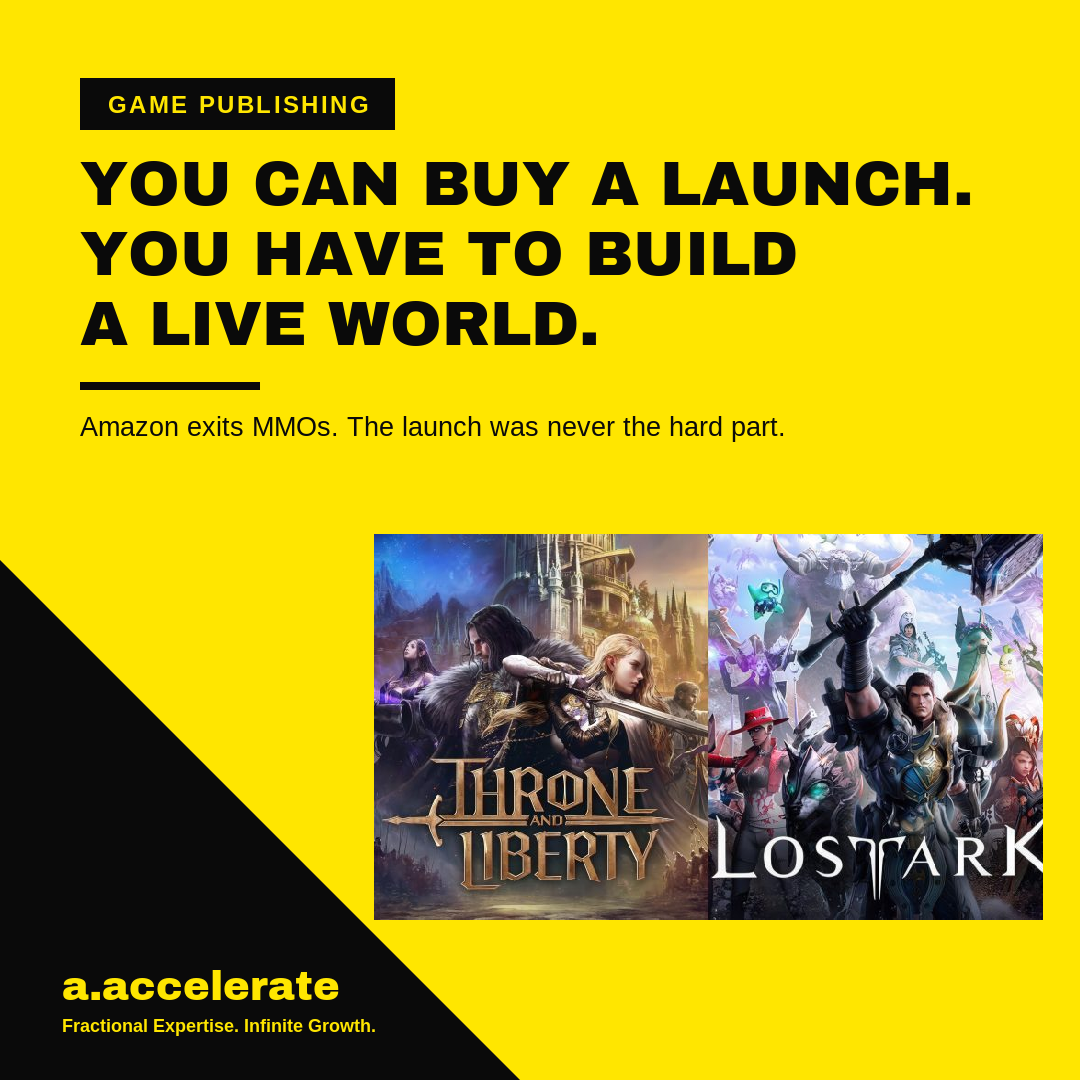
The headline is that Amazon is out of the MMO business. That's the least interesting part of the story.
On August 12, Amazon Games confirmed it will stop publishing Lost Ark and Throne and Liberty in the West. Throne and Liberty returns to NCSOFT in Q4 2026, Lost Ark to Smilegate in early 2027.
Neither game shuts down.
Amazon proved it could launch.
Throne and Liberty opened at 326,377 concurrent players on Steam. Lost Ark's 2022 Western launch hit 1.3 million. That's real distribution muscle, and Amazon delivered it.
What it never built was the other job: operating a live world.
One moment captured that gap better than any earnings note.
I remember analyzing a community issue started by Amazon's actions.
In January 2023, Amazon ran a ban wave against Lost Ark bot farms. It caught a large number of legitimate players, many with low playtime or who hadn't logged in for months. The listed reason was "Cheating." On Steam, that isn't just a lockout. It's a public mark on a player's profile, visible to everyone they play with.
Amazon reversed it, confirming they had "determined the error that triggered these false bans."
Look at how they found out.
Not through their own monitoring. Through appeal volume. Their words: "we've seen an increase in ban appeals from players who have been incorrectly impacted."
A team operating a live world asks different questions before shipping an enforcement action:
- What's our false-positive rate, and who checked it?
- What is the penalty's blast radius outside our game?
- Who is watching community channels in the first hour, not the first week?
You only ask those if you think you're running a place people live in, rather than a product you shipped.
Publishing a launch and operating a live world are different jobs.
A launch is a campaign. It ends.
A live world is an institution. It has memory, a social contract, and a cost structure that never stops.
The first can be bought. The second has to be staffed and sustained through years of unglamorous work.
Handing these games back to the studios that built them, rather than shutting them down like New World, is the trust-preserving version of leaving. Smilegate and NCSOFT have run them at home for years.
But if you're evaluating a publishing deal, ask what the partner brings after the launch:
- Who runs the Discord in year three?
- Who owns the sentiment report the week a bad patch ships?
- Who signs off on an action that touches a player's reputation outside your game?
If nobody can name a person, you have a distribution partner, not a live-service partner. Both are valuable. They are not interchangeable, and pricing one as the other is how studios end up rebuilding a relationship they thought they'd outsourced.
Trust in a live game is earned over years and is built with community focus and player empathy.
Everything else can be bought.