INSIGHTS / STEVE FOWLER
Pokémon Pokopia and the Brand DNA Exercise
2026-09-08
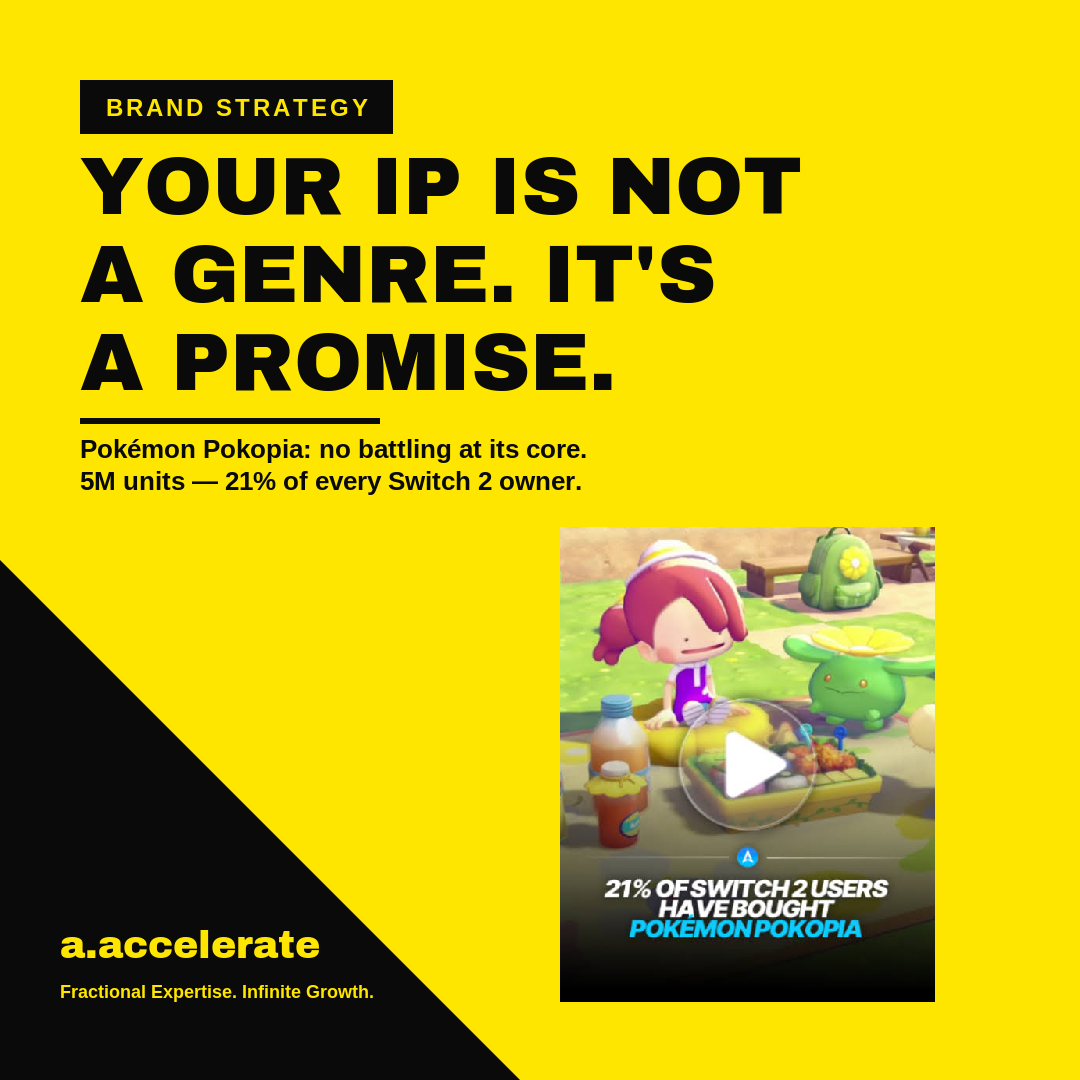
What would it take for one in five people who own a console to buy the same game?
Nintendo and The Pokémon Company announced this week that Pokémon Pokopia has passed 5 million units, just over four months after launch. Against a Switch 2 install base of 23.68 million, that's roughly a 21% attach rate and makes it the console's second-best-selling title behind Mario Kart World.
Pokopia is a life sim. You play as a Ditto and build out a world. Battling, one of the mechanics most associated with Pokémon, isn't the core loop.
Pokémon took its most valuable asset, moved it into a genre its audience wasn't necessarily asking for, and produced one of the platform's biggest hits.
There's a lesson here for anyone managing a game franchise.
Publishers often treat an IP and its genre as the same thing. Over time, the franchise becomes so closely tied to certain mechanics that it's difficult to imagine one without the other.
But mechanics aren't what make an IP durable.
The more valuable asset is the emotional promise the brand makes to its audience.
When I work with studios prelaunch, and when I teach this at USC, I use a brand DNA exercise that defines the game layer by layer:
- Purpose — why the game exists
- Values — what the team won't compromise
- Table stakes — what the category requires
- Functional benefits — what players can do
- Emotional benefits — how players feel
- Brand persona — how the brand behaves
- Brand promise — the idea holding it together
Most teams spend too much time at the functional level.
Weapons. Biomes. Traversal. Progression.
Those things matter, but they're features, and features are tied to genre.
For a franchise, emotional benefits and brand persona matter more because they can travel across genres.
Run the exercise on Pokémon and you probably arrive at collecting, companionship, discovery, and the comfort of inhabiting a welcoming world.
None of those require turn-based combat.
A life sim can deliver them just as well.
I did this kind of work while leading marketing on Hearthstone. It wasn't an academic exercise. You can't effectively brief trailers, store pages, creators and campaigns against "it's a card game." Teams need to understand what the brand is supposed to mean.
Of course, franchise extensions fail when publishers simply put a recognizable logo on a different game. The new experience still has to deliver the underlying promise of the IP.
Pokopia also had enormous advantages: Pokémon, Nintendo, platform exclusivity and a growing console install base.
But the underlying exercise is available to anyone.
Write down the three emotional promises your franchise makes to a player.
Then ask: What other kinds of games could deliver those same feelings?
If the only answer is the genre you're already making, you may not have defined your brand yet.
You've defined your product.